I’ve always been part of a minority.
First of all, I’m an engineer, that’s already a choice that is not that usual (unfortunately) for women (women in Engineering are around 20% in the US, while in Europe we reached a record percentage of 41% — Source Eurostat), secondly, I’m a Product Manager (35% of Product Management professionals in the U.S. are women).
However I cannot imagine myself in a different career path, and in the next lines, I want to explain why I love my job and why more women should choose this career as well. I will try to go through the “state of the art” product methodology and try to demonstrate why we can excel in this career and why we should be there.
Product Managers and Engineers are making the biggest advance in our society: from solving global warming to medical breakthrough innovations. They also create things that we use every day and are making our lives better, so with half of the population being female, we deserve to have the female perspective in this equation.
But as stated before at the moment this is fundamentally a boys club.
Let’s use Teresa Torres’ framework to go through the Product methodologies and discover why I believe if we sit at the table we can win this game and create an even better world through innovation and technology.
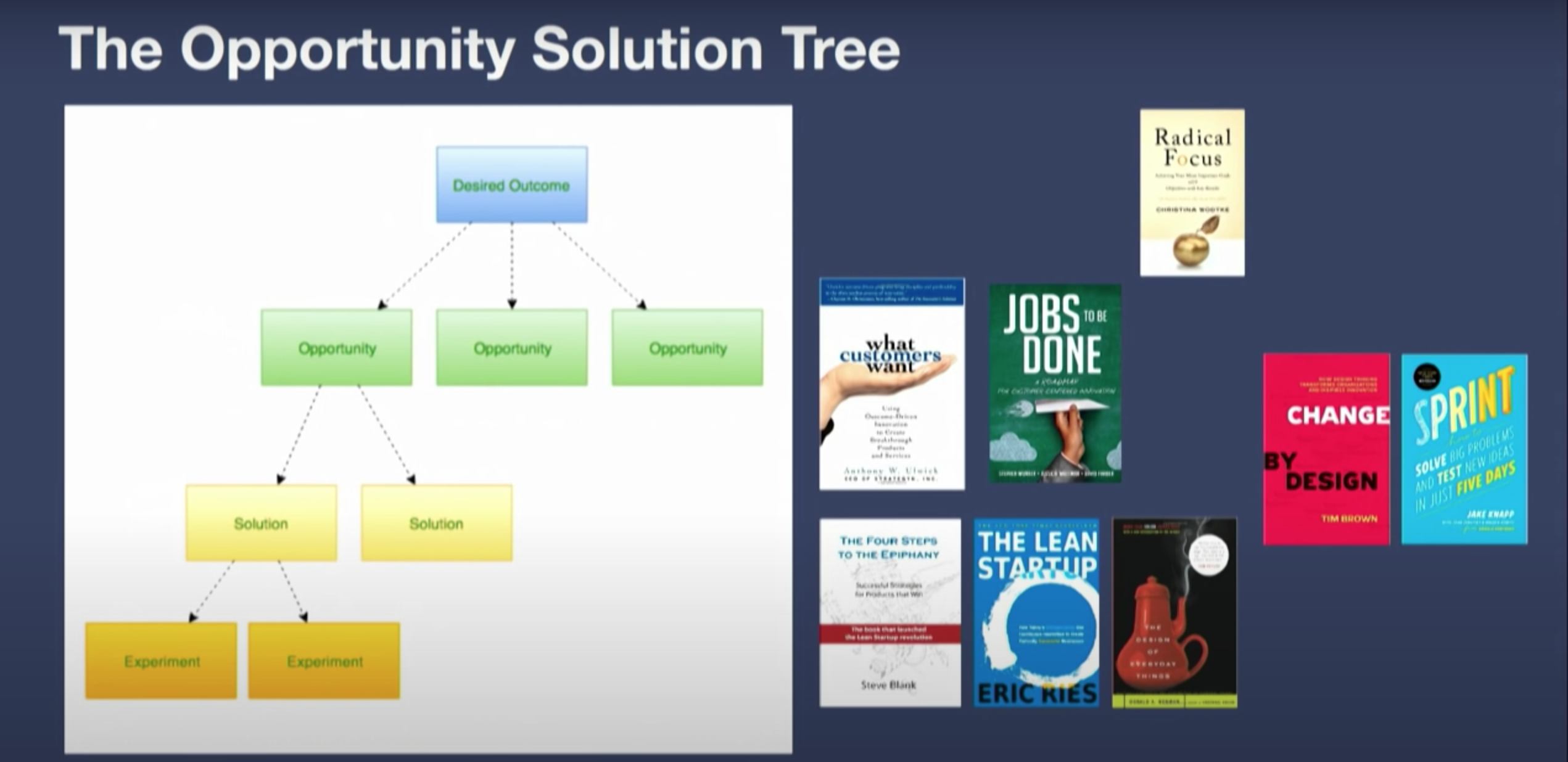
The Opportunity Solution Tree — the discovery framework at the center of this piece.
Modern product discovery is all about learning fast: we should understand in the fastest way possible if what we plan to build, is the right thing to build.
Speaking of learning, a study published by the American Psychological Association examines gender differences in schools across 300 countries and over nearly one hundred years. The findings may surprise you. It turns out girls have been getting better grades than boys for decades. Girls not only do markedly better in language classes, but they also outperform boys in math and science. The review includes 300 studies involving more than one million participants from across the globe, from elementary school through graduate school.
So here comes the first reason for a woman to become a product manager: we are fast in learning.
With Agile, for example, we’re answering the question: “Are we meeting our stakeholders’ requirements?” and we are answering this fundamental question every couple of weeks instead of waiting for six months, to discover too late that we’ve built a useless product (believe me I’ve been there - sic!). Moreover, if we read the Agile Manifesto:
Individuals and interactions over processes and tools
Working software over comprehensive documentation
Customer collaboration over contract negotiation
Responding to change over following a plan
We read behaviors and terms that are widely connected to women’s innate characteristics: interactions, collaboration, adaptability. On adaptability in particular, I want to quote a recent article on the female brain: “…The female brain…being more dynamic from a metabolic point of view and used to situations linked to hormonal variations, it is characterized by greater elasticity. In complex situations, therefore, women have an advantage, since the female brain is less ‘rigid’ and therefore led to analyze a wider spectrum of data and possibilities…”
In conclusion, a second reason for a woman to become a Product Manager: her adaptable brain is perfectly conceived to work in an Agile environment.
With User Experience Design we answer another fundamental question: “Can customers use this?” To execute User Testing we now have dozens of methodologies, but it all comes down to listening to the customer’s feedback to make our product more usable. Listening to needs is undoubtedly a female characteristic forged by centuries of evolution in the mothership role.
Finally, arriving where the Product Strategy is created: through Design Thinking we are answering the question “Are we solving a problem customers care about?” To exploit the methodology, the principal skill we need to practice is empathy. Empathy is about creating trustful relationships and here’s where the oxytocin (aka cuddle-hormone) comes into play. This is now the third and probably more compelling characteristic that should convince a woman to embark on this adventure, convinced that she will succeed: her capacity to create empathetic relationships.
Are women perfect in this role? To be honest, in my experience there’s an area where we need to put our solid attention. If you refer back to Teresa’s representation, the outcome territory is the one where we need to focus the most. OKR framework is for sure a great model, but women, especially in senior context, are often reluctant to talk about money, and in the vast majority of cases companies are setting the most important OKRs around financial results. Business acumen is a skill that most women need to learn, and in our careers we are not enough solicited to improve it.
In summary, these 3 women characteristics:
- Being fast learners
- Adaptability
- Empathy
are the perfect fit into a Product Management role, and I encourage my readers, men and women, to share this view and urge women to take stock into this and create a better world together with men.